Monday, March 28, 2011

Media Experiment #5


The slasher film has always been a love/hate genre. I’ve always had an intense love of horror films, but I would never classify the slasher film as a true horror. Slasher films rely on shock value, not on true story telling; the romantic comedy of the horror film world. I don’t dislike it because of the presentation of females.Yet, just like romantic comedies, there are always people going to see them, and there will always be another slasher film in theaters. I think the main reason people are drawn to slasher films is the same reason why they are hated by so many. They rely on the presentation of the body, and more importantly, the female body. As presented in the film Tough Guise: Violence, Media, and the Crisis in Masculinity, in slasher films the “film” always occurs right after the female is either nude or there is some pseudo-sexual moment. This does present the male as the stabbing, sex driven character and the female as the helpless victim who is only around for her breasts. However, I felt that was a very shallow interpretation of the gender roles in slasher films, and the roles go much deeper. Carol Clover analyzes these roles further in her essay Her Body, Himself, specifically using the films Texas Chainsaw Massacre II and Nightmare on Elm Street. First, Clover analyzes the killer themselves. They are often male, yes, but they are not “sex driven.” Usually they are somewhat stuck in boyhood confusion, and killing becomes are alternate for sex. The  victims are often females, and teenage, but there are always male victims. The male victims are usually killed off quickly, which Clover suggests is to present that the “brave” and “could be survivors” are not the real masculine ones, and masculinity can only exist in relation to the female body. Finally, there is always the “final girl.” Yet, rather than being killed, she often survives, by being brave, and calming down the killer. This is far different from the soulless victim that is described in Tough Guise, who is only killed because she is a female who is sexually attractive.
The gender roles in slasher films cannot be so neatly described because they are constantly changing. There is no “alpha sex” presented in the slasher films, and while the draw of seeing a womans breast is still a possibility and thrill for a primarily male audience, I personally don’t feel that anyone goes into slasher films thinking less of woman or feeling that to get sexually fulfilled they need to stab someone. It is simply story telling that can reach a broad audience, and potentially scare them.


            Shows such as Mad Men, however I feel are good windows into the view of gender roles in the 60s. While a completely opposite end of a slasher film, it is similar in that it reaches a huge audience, and the characters are meant to fulfill stereotypes. The men in Mad Men are the definition of chauvinistic, leaders, and modern day Casanova. The females fit all the female “stereotypes” of submissive, vain, motherly, and who can only be placed in the menial jobs. This show, while presenting a certain timeframe where these were jobs seen, is incredibly sexist. It seems to go unnoticed because it is critically acclaimed. While the slasher film is often analyzed and criticized, mostly because it is an easy target. Mad Men glorifies and fetishes the sexist nature of the 60s, rather than self-criticizing it. The males become the heroes to the audience, while the females become the people who the audience are rooting against. I feel that if anything, Mad Men are doing more to set back gender stereotypes more than any slasher film ever could. Being a female, it's difficult to see shows Mad Men get so much fame and glory, where the sexism is just simply brushed off as "perfect portrayal" of the times. I want there to be less talk about how fantastic the show is, and more talk about the over-the-top sexism.

Below is a parody of the sexism on Mad Men


Thursday, March 10, 2011

Media Experiment #4


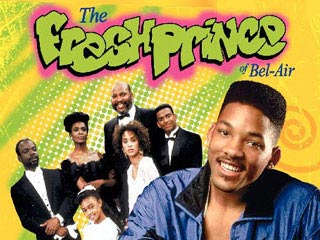
The Fresh Prince of Bel Air is a show featured an African American family, that was well off, happy, and seemingly very comfortable finically. The family, Banks, takes in their nephew from Philadelphia. The family life of the father who is a Judge, the attractive and thin stay at home mother, the two daughters, one who is a vain and the other slightly naive, and Carlton, the “white washed” character who is always taunted for not being “black” enough is completely in disarray. Will, played by Will Smith is the certainly the most “ethnic” of the characters, and is seen as the hero. The Banks family who seems to want to blend into white culture of Bel Air, are often the butt of Will’s antics. The show itself seems to analyze how many African Americans feel the need to blend into white culture, and how this pits against those African Americans who do not do so. In some episodes, Will is the one getting in trouble, while the “grounded” Banks family has to rescue him from yet another disaster. Other episodes it is Will who seems to teach the up-tight Banks family a lesson. Either way, race is constantly at a forefront, as it analyzes and pokes-fun at both these stereotypes. Who is the role-model of the show, goof-ball Will, or the rich successful Banks family, who seems to have abandoned their African-American roots?
Below is a video of Will's typical take on Carlton, and what happens when Carlton tries to slip into a more African American role

http://www.youtube.com/watch?v=USb-XNYqjZk


A similar way of African Americans are used by the media is through advertisements. Take for example the ad seen below, where there are a group of African American men standing together. This advertisement, from a campaign in 1970, was a break from the norm for African American’s in advertising. Where as before, the goal was to target African American’s specifically for a product, or even for a different product all together, this was the only campaign up to that point that featured the same copy, and overall image in it’s ad; the only difference is that the subjects are African American. In the 70’s, advertisements used such phrases as “Dig it” and “Have mercy!” Phrases that were hip at that time and used by African Americans. From the presentation of the Budwiser ad, the trend for advertising seems to be placing African Americans in typically “white” settings with “white” products, like Ralph Lauren and Tommy Hilfiger. This is similar to the presentation of race in Fresh Prince; the Banks family is the subjects in the ads, and Will is the African American consumer. 


Media seems to be attempting to redefine their idea of what the “role” and “place” of African American’s are, by slipping them into advertisements that would reach a broader base, or maybe even attempting to have them redefine themselves, by trying to force into a role that they feel more comfortable seeing them in. This agrees with what Clint C. Wilson says in his piece "Advertising and People of Color" Wilson writes that advertising has reflected the place of non-white. Or that when included it was in a stereotypical way. catering to the way whites saw African Americans. So then what can be said about the African American advertising we see today? Wearing Polo and Abercrombie. Is the reflection that we want to see them as being white? I feel that putting African Americans in typically White population brands is not an elimination of race, but a highlight of how uncomfortable race still makes society-trying to cover it up; a "wolf in sheep's clothing" by the media.

I relate this to the movie Bamboozled by Spike Lee. In that film there was blatant racism, though not as extreme as the examples I've provided here today. But that blatant racism was left unnoticed in the film, just as it is in everyday life. I'm not going to sit here and act like I'm not entertained by Fresh Prince, and I've watched it since I was a little kid. But there is that idea of acceptance, or because we've watched these shows and seen them for so long we've become assimilated. Just as in Bamboozled, it was never questioned. I think these things remain unquestioned because just as in Bamboozled, the actors in Man Tan were African American. "In Fresh Prince the characters are African American, so the actors must be okay with how they are portrayed" or "They agreed to do the advertisement, so it must be fine." The reality is is that these actors or models don't have a say of how they're portrayed; they are portrayed the way media forces them to do so.

Wednesday, March 2, 2011

Media Experiment #3


When I moved to college, my family made the decision that I would not be taking a TV with me. “It’ll be distracting” was the main complaint from my parents. Part of me was dreading it, what was I going to do when I got bored. It was another comfort from home that I felt I was. I grew up in a house that had a TV in essentially every room, and suddenly was going to have zero. Yet after almost two years without one, I don’t feel like I’m missing anything.
TV used to be the first thing I would be drawn to after coming home from school when I was younger; I’d set my book bag down and settle in on the sofa and watch hours of TV. With the lack of it in my dorm, I don’t feel like much is forgotten. I realized it’s because when I used TV, it was simply background noise, something to focus on in my boredom. Rarely (if ever) was I engaged completely. There was the occasional episode of my favorite show that I would set out to watch, but other than that it was channel flipping and barely listening.
Even now when I go to public places and a TV is on, it is not the focus of my attention. I’ll sit in the restaurant and maybe catch a word that is said here or there. But rarely do I focus on the screen. TV has become a nonexistent entity for me. It just serves as a space filler, or better yet, noise filler. It fills the places that seem to not want any silence- restaurant, bars, peoples homes. Yet I’ve noticed that as time has gone on I’ve found more ways for that space to be filled, such as portable music devices, that can fill noise wherever I go.
Film on the other hand, is a more “set out” I make a plan to go to a film, at a certain time, at a certain place, and it is done at my decision. TV often bombards me when I do not want it to. I don’t decide to go to a restaurant because I know they’re will be a TV present, I go to eat a meal. If I want TV to find me, I’ll go to the internet. But it seems to be that the TV as it exists now is becoming almost a nuisance for me. After living without it, I’ve realized that in my life it is completely unnecessary. I almost find it cumbersome when I walk into a place and a TV is on, as if I am forced to now be engaged with it, though it was not my original intention. Where TV use to be something exclusively for the home, it has completely shifted roles into something that is not only not needed, but something uninvited.
When I watch TV now, I find myself annoyed by the number of commercials, or that I can’t find the exact show I want. Where film and online TV shows can be found to cater my exact needs and wants, TV has it’s own agenda that I have to adapt to. There seems to be no control over TV, which I find increasingly frustrating. TV is no longer a leisure activity but something I wish to escape from.

What was once defined by McLuhan as a "cold" media, has now become "hot." I don't interact with TV in public because it's always around. I don't think about doing it, just like I don't think about breathing. I think this is because television has lost most of it's power. Raymond Williams argues in his chapter "The Technology and the Society" that television has "altered our world" and that it has the power to persuade a group of people. Hearing these things now, it almost seems humors. I think of the TVs I see in bars, and how they serve as simple background noise; another flashy piece of decor in the corner of the bar. TV doesn't have the power to change a society anymore, and whatever it "altered" it's noticeable anymore. TV is just part of the everyday, because it's out with us everyday.