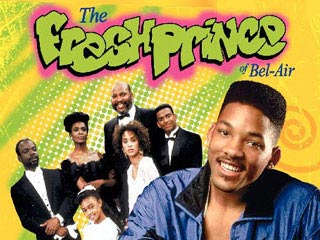
The Fresh Prince of Bel Air is a show featured an African American family, that was well off, happy, and seemingly very comfortable finically. The family, Banks, takes in their nephew from Philadelphia. The family life of the father who is a Judge, the attractive and thin stay at home mother, the two daughters, one who is a vain and the other slightly naive, and Carlton, the “white washed” character who is always taunted for not being “black” enough is completely in disarray. Will, played by Will Smith is the certainly the most “ethnic” of the characters, and is seen as the hero. The Banks family who seems to want to blend into white culture of Bel Air, are often the butt of Will’s antics. The show itself seems to analyze how many African Americans feel the need to blend into white culture, and how this pits against those African Americans who do not do so. In some episodes, Will is the one getting in trouble, while the “grounded” Banks family has to rescue him from yet another disaster. Other episodes it is Will who seems to teach the up-tight Banks family a lesson. Either way, race is constantly at a forefront, as it analyzes and pokes-fun at both these stereotypes. Who is the role-model of the show, goof-ball Will, or the rich successful Banks family, who seems to have abandoned their African-American roots?
Below is a video of Will's typical take on Carlton, and what happens when Carlton tries to slip into a more African American role
http://www.youtube.com/watch?v=USb-XNYqjZk

Below is a video of Will's typical take on Carlton, and what happens when Carlton tries to slip into a more African American role
http://www.youtube.com/watch?v=USb-XNYqjZk
A similar way of African Americans are used by the media is through advertisements. Take for example the ad seen below, where there are a group of African American men standing together. This advertisement, from a campaign in 1970, was a break from the norm for African American’s in advertising. Where as before, the goal was to target African American’s specifically for a product, or even for a different product all together, this was the only campaign up to that point that featured the same copy, and overall image in it’s ad; the only difference is that the subjects are African American. In the 70’s, advertisements used such phrases as “Dig it” and “Have mercy!” Phrases that were hip at that time and used by African Americans. From the presentation of the Budwiser ad, the trend for advertising seems to be placing African Americans in typically “white” settings with “white” products, like Ralph Lauren and Tommy Hilfiger. This is similar to the presentation of race in Fresh Prince; the Banks family is the subjects in the ads, and Will is the African American consumer.

Media seems to be attempting to redefine their idea of what the “role” and “place” of African American’s are, by slipping them into advertisements that would reach a broader base, or maybe even attempting to have them redefine themselves, by trying to force into a role that they feel more comfortable seeing them in. This agrees with what Clint C. Wilson says in his piece "Advertising and People of Color" Wilson writes that advertising has reflected the place of non-white. Or that when included it was in a stereotypical way. catering to the way whites saw African Americans. So then what can be said about the African American advertising we see today? Wearing Polo and Abercrombie. Is the reflection that we want to see them as being white? I feel that putting African Americans in typically White population brands is not an elimination of race, but a highlight of how uncomfortable race still makes society-trying to cover it up; a "wolf in sheep's clothing" by the media.
I relate this to the movie Bamboozled by Spike Lee. In that film there was blatant racism, though not as extreme as the examples I've provided here today. But that blatant racism was left unnoticed in the film, just as it is in everyday life. I'm not going to sit here and act like I'm not entertained by Fresh Prince, and I've watched it since I was a little kid. But there is that idea of acceptance, or because we've watched these shows and seen them for so long we've become assimilated. Just as in Bamboozled, it was never questioned. I think these things remain unquestioned because just as in Bamboozled, the actors in Man Tan were African American. "In Fresh Prince the characters are African American, so the actors must be okay with how they are portrayed" or "They agreed to do the advertisement, so it must be fine." The reality is is that these actors or models don't have a say of how they're portrayed; they are portrayed the way media forces them to do so.
I relate this to the movie Bamboozled by Spike Lee. In that film there was blatant racism, though not as extreme as the examples I've provided here today. But that blatant racism was left unnoticed in the film, just as it is in everyday life. I'm not going to sit here and act like I'm not entertained by Fresh Prince, and I've watched it since I was a little kid. But there is that idea of acceptance, or because we've watched these shows and seen them for so long we've become assimilated. Just as in Bamboozled, it was never questioned. I think these things remain unquestioned because just as in Bamboozled, the actors in Man Tan were African American. "In Fresh Prince the characters are African American, so the actors must be okay with how they are portrayed" or "They agreed to do the advertisement, so it must be fine." The reality is is that these actors or models don't have a say of how they're portrayed; they are portrayed the way media forces them to do so.

I read your comment on this issue and I cannot help but agree with how you said this applies to the LGBT community and their representation in media as well. I have consistently heard that because of the harsh controversy the community often faces, especially in media, that 'any representation' at all seems better than none. I wonder if this is the same sentiment that existed at the start of African American representation in the media. In its own way it does make sense, but of course we need to step away from these types of portrayals that do anything but empower a race or gender as they perpetuate stereotypical mindsets.
ReplyDelete